Physical Address
Lahore, Punjab, Pakistan
Physical Address
Lahore, Punjab, Pakistan

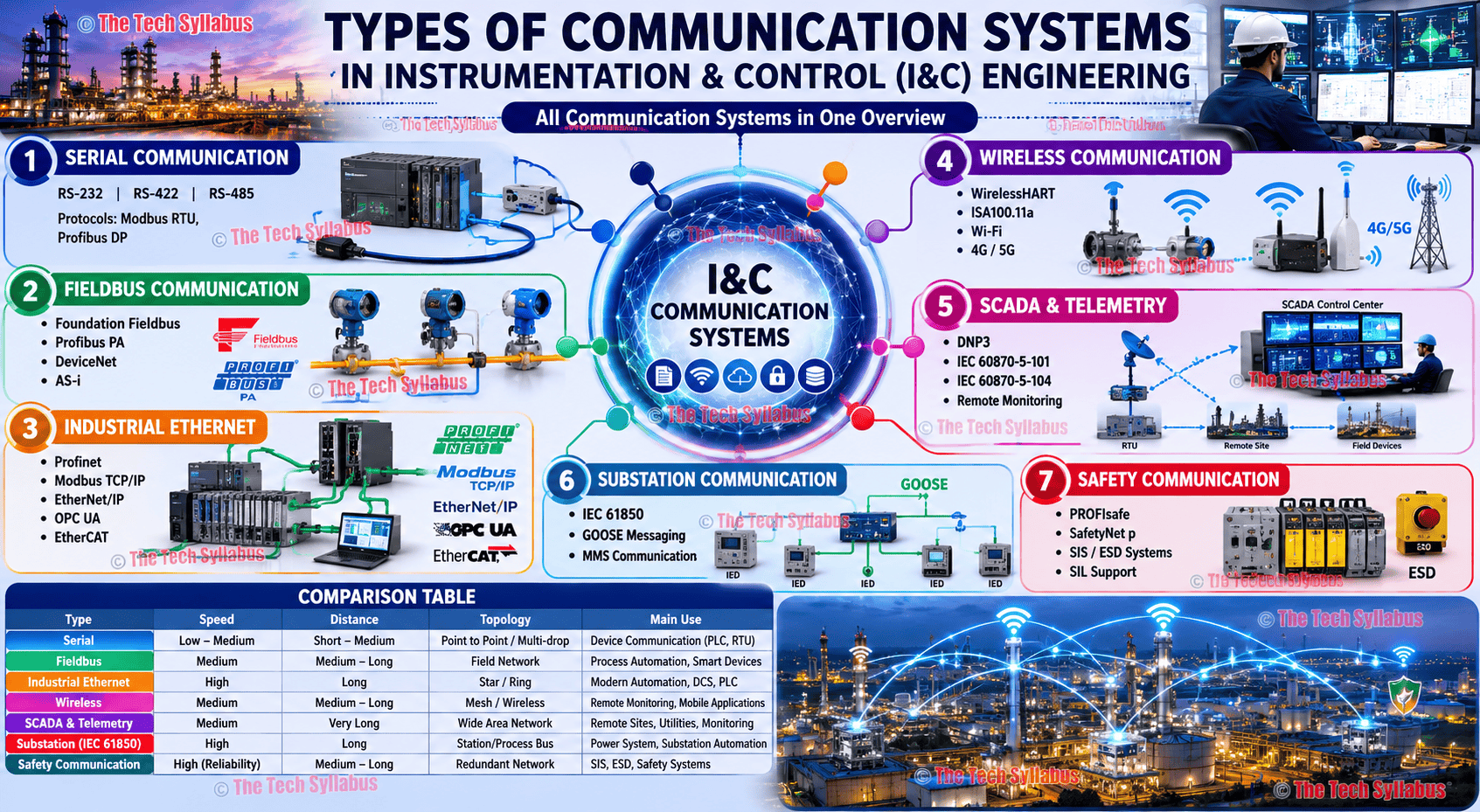
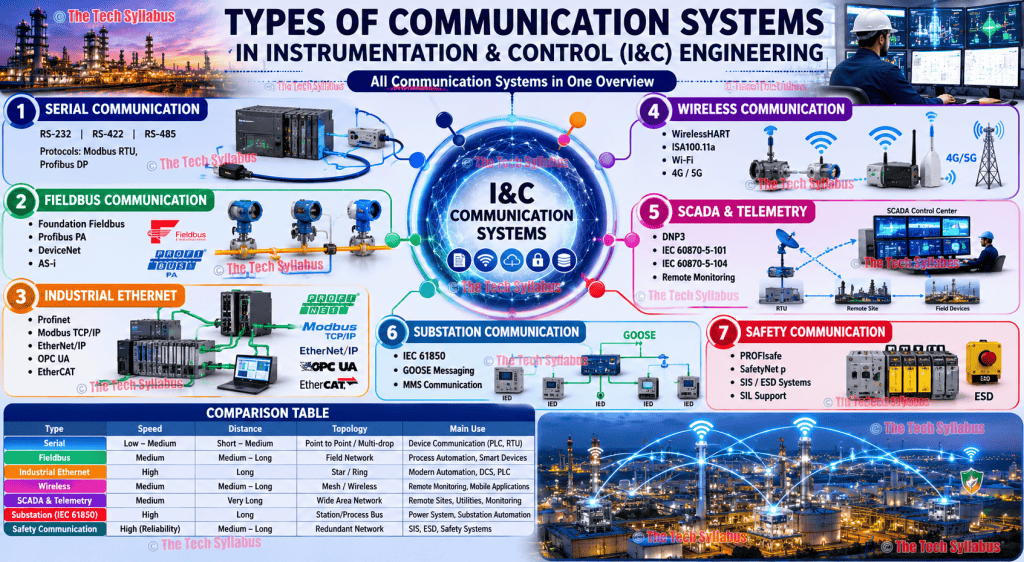
Communication systems in Instrumentation and Control (I&C) Engineering are used to transfer process data between field instruments, controllers, PLCs, DCS systems, SCADA platforms, and actuators. These communication systems enable real-time monitoring, control, diagnostics, and automation of industrial processes.
Modern industries such as power plants, oil and gas facilities, chemical plants, water treatment plants, and manufacturing industries rely heavily on communication networks to ensure safe, reliable, and efficient operations. The main types of communication systems used in I&C Engineering include analog communication, digital communication, serial communication, fieldbus communication, industrial Ethernet, wireless communication, SCADA and telemetry communication, fiber-optic communication, substation communication, and safety communication systems.
A communication system is a method used to transfer information between industrial devices such as sensors, transmitters, PLCs, DCS controllers, operator workstations, and enterprise systems.
The primary objective of industrial communication is to ensure that process data is transmitted accurately, reliably, and securely throughout the automation hierarchy.
Industrial communication systems provide several advantages:
Without effective communication networks, modern automation systems cannot operate efficiently.
Analog communication is one of the oldest methods used in industrial instrumentation.
Digital communication transmits information in binary form and supports intelligent devices.
Serial communication transfers data one bit at a time between devices.
Fieldbus technology allows multiple field devices to communicate through a single network cable.
Industrial Ethernet is currently the most widely used communication technology in industrial automation.
Wireless communication eliminates the need for extensive cabling and provides flexibility in remote applications.
SCADA and telemetry systems enable centralized monitoring and control of geographically distributed assets.
Fiber-optic communication uses light signals for high-speed and long-distance data transmission.
Modern substations rely on advanced digital communication technologies.
Safety communication networks are designed for Safety Instrumented Systems (SIS) and Emergency Shutdown Systems (ESD).
The most widely used communication protocols in industrial automation include:
| Protocol | Typical Application |
|---|---|
| HART | Smart Field Instruments |
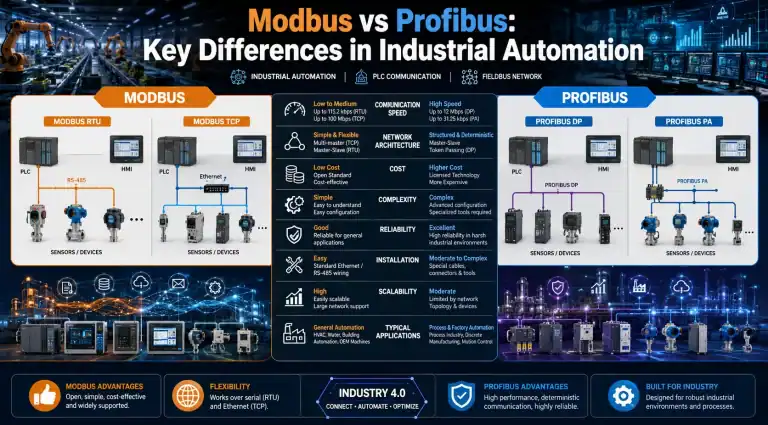
| Modbus RTU | Serial Device Communication |
| Modbus TCP | Ethernet Communication |
| Profibus DP | Factory Automation |
| Profibus PA | Process Automation |
| Foundation Fieldbus | Process Industries |
| Profinet | Industrial Ethernet |
| EtherNet/IP | Manufacturing Systems |
| OPC UA | Data Integration |
| IEC 61850 | Substation Automation |
| Communication Type | Speed | Distance | Typical Application |
| Analog | Low | Medium | Conventional Instrumentation |
| Digital | Medium | Medium | Smart Devices |
| Serial | Medium | Long | PLC Communication |
| Fieldbus | Medium | Medium | Process Automation |
| Industrial Ethernet | High | Long | Modern Automation Systems |
| Wireless | Medium | Medium-Long | Remote Monitoring |
| Fiber Optic | Very High | Very Long | Industrial Backbone Networks |
| SCADA & Telemetry | Medium | Very Long | Remote Operations |
| Substation Communication | High | Long | Power Systems |
| Safety Communication | High Reliability | Medium | SIS & ESD Systems |
When selecting a communication system, engineers should consider:
The main types are analog, digital, serial, fieldbus, industrial Ethernet, wireless, SCADA and telemetry, fiber-optic, substation, and safety communication systems.
Modbus, Profinet, Profibus, HART, Foundation Fieldbus, and OPC UA are among the most widely used industrial communication protocols.
RS-485 supports long communication distances, excellent noise immunity, and multi-device communication, making it suitable for industrial environments.
HART combines digital communication with a 4–20 mA analog signal, while Foundation Fieldbus is a fully digital communication system.