Physical Address
Lahore, Punjab, Pakistan
Physical Address
Lahore, Punjab, Pakistan

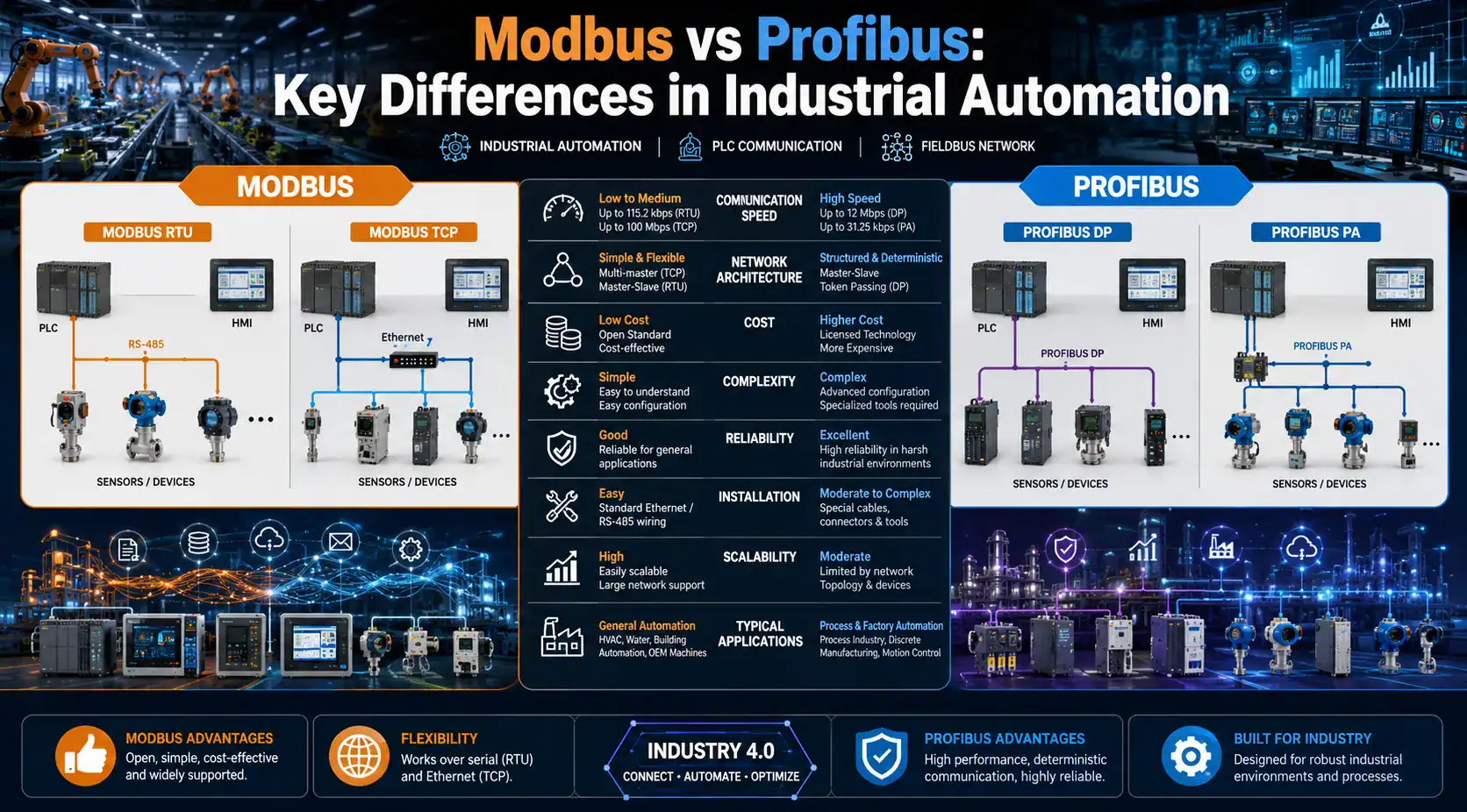
Imagine a large power plant or a busy factory floor. Dozens of sensors, motors, valves, and controllers are working together. But how do they all communicate? The answer is communication protocols.
In the world of industrial automation, two names come up repeatedly: Modbus and Profibus. These are two of the most commonly used fieldbus communication protocols in the industry. Whether you are a new engineering student, an experienced PLC programmer, or a plant maintenance technician, knowing the difference between these two can save you time, money, and a lot of troubleshooting headaches.
This article will teach you everything that you need to know about Modbus versus Profibus in terms that are easy to understand.
Modbus is one of the oldest industrial communication protocols in existence. It was developed by Modicon in 1979 — yes, that is over 40 years ago. Despite its age, Modbus is still used everywhere in modern industrial systems. That tells you something about how reliable and simple it really is.
At its core, Modbus is a request-response protocol. One device (the master) asks for data, and another device (the slave) responds. It is a simple master-slave architecture that is easy to implement and understand.
There are three main versions of Modbus that you will come across:
Modbus RTU (Remote Terminal Unit) is the most commonly used version. It runs over RS-232 or RS-485 serial communication. It is compact, binary-encoded, and very efficient. Most field instruments like temperature transmitters, flow meters, and PLCs support Modbus RTU.
Modbus ASCII is an older, less common version. It encodes data as ASCII characters, making it human-readable but slower.
Modbus TCP/IP is the modern version. It runs over standard Ethernet networks, making it easy to integrate with SCADA systems, HMIs, and even cloud-based monitoring platforms. If you are building a new system today, Modbus TCP is likely your go-to choice.
Think about a boiler plant. A temperature transmitter on a steam line sends temperature data to a PLC every second. The PLC reads this data over Modbus RTU. The PLC then feeds this into a SCADA system through Modbus TCP. Simple, clean, and reliable.
Profibus stands for Process Field Bus. It was developed in Germany in 1987 and later standardized under IEC 61158. Profibus was designed from the start for high-speed, reliable communication in complex industrial environments.
Unlike Modbus, which uses a simple master-slave model, Profibus uses a more advanced token-passing and master-slave hybrid architecture. This allows for faster and more deterministic communication — meaning you can predict exactly when a message will arrive.
There are two main variants:
Profibus DP (Decentralized Periphery) is the most common type. It is designed for fast communication between PLCs and field devices like drives, I/O modules, and sensors. Profibus DP is fast, reliable, and widely supported by automation equipment manufacturers.
Profibus PA (Process Automation) is used in environments where you need intrinsic safety, such as oil refineries, chemical plants, and gas processing facilities. It uses a lower power supply and supports devices in hazardous zones classified as Zone 0, 1, and 2 per IEC standards.
In a large turbine control system, the DCS (Distributed Control System) communicates with dozens of smart field instruments — pressure transmitters, control valves, and positioners — all connected on a single Profibus PA segment. The system is deterministic, fast, and supports advanced diagnostics. This is why you see Profibus heavily used in oil and gas, pharmaceutical, and large-scale power generation plants.
This is one of the biggest areas where the two protocols differ.
Modbus uses a simple master-slave architecture. There is always one master (typically a PLC or SCADA system) and up to 247 slaves on an RS-485 network. Only the master can initiate communication. The slaves just wait and respond when called. This simplicity is both its strength and its limitation.
Profibus uses a more advanced architecture. On a Profibus DP network, you can have one or more masters. The masters pass a logical “token” between themselves, taking turns to communicate with their respective slaves. This multi-master capability makes Profibus far more powerful for large, complex installations.
Speed matters a lot in industrial control systems. Here is how the two compare.
Modbus RTU over RS-485 supports speeds from 1200 baud up to 115,200 baud (115.2 kbps). This is fine for many applications, but it can become a bottleneck in large networks with many devices.
Modbus TCP over Ethernet can reach standard Ethernet speeds — effectively 10 Mbps to 1 Gbps — though the protocol overhead limits real throughput.
Profibus DP is significantly faster in its native form. It supports speeds from 9.6 kbps up to 12 Mbps, with most industrial installations running at 1.5 Mbps or higher. For real-time control applications — like controlling servo drives in a production line — Profibus DP’s speed and determinism give it a clear edge.
Modbus RTU uses a simple daisy-chain (bus) topology over RS-485 cable. Installation is straightforward. You need a twisted-pair cable, proper termination resistors at each end, and you are ready to go. Maximum cable length depends on baud rate — at 9600 baud, you can go up to 1200 meters.
Profibus DP also uses a bus topology, but with a specific cable type: a shielded twisted-pair cable (Type A cable per EN 50170). Maximum cable length at 12 Mbps is 100 meters, but at lower speeds like 187.5 kbps, it can reach 1000 meters. Profibus also supports fiber optic and wireless variants for special environments.
Modbus TCP uses standard Ethernet topology — star, ring, or mesh. This is a huge advantage if you are already running an Ethernet infrastructure in your plant.
| Feature | Modbus RTU/ASCII | Modbus TCP | Profibus DP | Profibus PA |
|---|---|---|---|---|
| Developed By | Modicon | Modicon | Siemens & Others | Siemens & Others |
| Year Introduced | 1979 | 1999 | 1987 | 1993 |
| Standard | Open / De facto | Open / De facto | IEC 61158 | IEC 61158 |
| Communication Model | Master-Slave | Master-Slave | Multi-Master + Slave | Master-Slave |
| Physical Layer | RS-232 / RS-485 | Ethernet | RS-485 (Type A Cable) | MBP (Manchester Bus Powered) |
| Max Speed | 115.2 kbps | Up to 1 Gbps | 12 Mbps | 31.25 kbps |
| Max Devices | 247 (RS-485) | Virtually unlimited | 126 per segment | 32 per segment |
| Max Cable Length | 1200 m (at 9600 baud) | Depends on Ethernet | 100 m (at 12 Mbps) | 1900 m |
| Determinism | No | No | Yes | Yes |
| Intrinsic Safety | No | No | No | Yes (Zone 0/1/2) |
| Diagnostics | Basic | Basic | Advanced | Advanced |
| Installation Cost | Low | Low–Medium | Medium–High | High |
| Configuration Complexity | Low | Low | Medium–High | High |
| Typical Use Case | SCADA, Energy Meters, PLCs | SCADA, Remote Monitoring | Drive Control, I/O Modules | Oil & Gas, Chemical Plants |
| Open or Proprietary | Open | Open | Open (but complex) | Open (but complex) |
| Vendor Support | Universal | Universal | Very Wide | Wide |
Simple and easy to understand. Any engineer can learn Modbus in a day. The register-based data model (coils and holding registers) is straightforward.
Universally supported. Almost every PLC, sensor, drive, and energy meter on the market supports Modbus. It is truly the common language of industrial automation.
Low cost. No special hardware or software is needed. A basic RS-485 converter and free configuration software are enough to get started.
Open standard. No licensing fees. No vendor lock-in. You are free to use it on any device, from any manufacturer.
Easy troubleshooting. Because the protocol is simple, diagnosing faults is relatively easy with basic tools like serial port monitors or Wireshark (for Modbus TCP).
Not deterministic. You cannot guarantee when a message will arrive. For time-critical control loops, this is a problem.
Limited built-in diagnostics. Modbus tells you if there is an error, but it does not give you detailed device health information.
Single master limitation (RTU). Only one master can control the bus. No redundancy is built in.
Slow for large networks. If you have 50 devices on a single Modbus RTU segment, polling all of them takes time.
Fast and deterministic. Data arrives at a guaranteed, predictable time. This is critical for real-time control — like synchronizing multiple servo motors on a production line.
Advanced diagnostics. Profibus devices can report detailed status information — things like valve position feedback, transmitter sensor failures, and configuration errors. This supports predictive maintenance programs.
Multi-master support. Multiple PLCs or DCS controllers can share the same Profibus network.
Highly scalable. Profibus DP can support up to 126 devices per network segment, with repeaters extending the network further.
Intrinsic safety (PA). Profibus PA devices can be installed in hazardous areas without additional safety barriers in most cases.
Complex configuration. Setting up Profibus DP requires GSD (General Station Description) files, proper bus parameterization, and careful address management. It is not something you pick up in an afternoon.
Higher cost. Profibus hardware, cables, and connectors are more expensive than standard RS-485 components.
Requires specialist knowledge. Troubleshooting Profibus networks — especially PA — often requires dedicated diagnostic tools and trained personnel.
Vendor dependency. While Profibus is an open standard, practical implementation often ties you to specific vendors (especially Siemens-based systems).
Energy metering and power monitoring are classic Modbus applications. Energy meters from brands like Schneider, ABB, and Siemens all speak Modbus RTU. A PLC or energy management system polls them every few seconds to track consumption.
Water and wastewater treatment plants often use Modbus because of its simplicity and the wide range of compatible sensors — level transmitters, pH sensors, and flow meters.
Building automation systems (BAS) frequently use Modbus TCP to connect chillers, AHUs, and other HVAC equipment to a central BMS (Building Management System).
Small and medium industrial facilities with straightforward control architectures — boiler control panels, compressor stations, generator monitoring.
Large automotive manufacturing plants use Profibus DP to control robot arms, conveyor drives, and production line I/O — where every millisecond counts.
Oil refineries and chemical plants rely on Profibus PA for intrinsically safe connections to field instruments in hazardous zones.
Pharmaceutical manufacturing uses Profibus PA for precise process control with full diagnostic capabilities — critical for FDA compliance and GMP (Good Manufacturing Practice) requirements.
Power generation facilities — large turbine control systems with Siemens or ABB DCS platforms are almost always built on Profibus DP backbones.
This is the question most engineers ask after learning about both protocols. The honest answer is: it depends on your specific application. Here is a practical guide to help you decide.
Choose Modbus if:
Choose Profibus if:
Consider Modbus TCP as a middle ground. If you need the simplicity of Modbus but want modern Ethernet infrastructure and higher throughput, Modbus TCP is an excellent option. Many modern installations run Modbus TCP for SCADA integration while using Profibus DP at the field level.
Q1. Is Modbus still relevant in 2026? Absolutely. Modbus remains one of the most widely deployed industrial protocols in the world. Its simplicity, low cost, and universal support ensure it will remain relevant for many years, especially in legacy systems, energy monitoring, and budget-sensitive applications.
Q2. What is the maximum number of devices on a Modbus RTU network? Modbus RTU over RS-485 supports up to 247 slave devices on a single bus. In practice, most installations keep it under 32 devices for reliability and response time reasons.
Q3. Can Modbus and Profibus coexist in the same plant? Yes, and this is very common. Many plants use Profibus DP or PA for critical process control at the field level, while using Modbus TCP for energy monitoring and SCADA integration at a higher level. Gateways and protocol converters are widely available to bridge the two networks.
Q4. What does “deterministic communication” mean, and why does it matter? Deterministic means that messages are delivered within a guaranteed time frame. In Profibus, you know exactly when each device will receive its data update. In Modbus, polling is sequential, and timing depends on network load. For time-critical applications like motor drive control or safety systems, determinism is essential.
Q5. Which protocol is easier to troubleshoot? Modbus is generally easier to troubleshoot. Its simplicity means fewer things can go wrong, and basic tools like a serial port monitor are sufficient. Profibus troubleshooting requires specialized diagnostic tools and a deeper understanding of the network architecture.
Q6. Is Profibus PA the same as HART? No, they are different protocols, but they serve similar purposes — connecting intelligent field instruments in process plants. HART (Highway Addressable Remote Transducer) is a hybrid protocol that superimposes digital communication over 4-20 mA analog signals. Profibus PA is a fully digital protocol with its own physical layer (MBP). In modern installations, Profibus PA and HART are both common choices for smart instrumentation.
Q7. What is the difference between Profibus DP and Profibus PA? Profibus DP is optimized for fast data exchange between PLCs and factory automation devices. It operates at up to 12 Mbps. Profibus PA is designed for process industries and hazardous areas. It runs at 31.25 kbps but provides power to field devices over the same two-wire cable, making it suitable for intrinsically safe installations.
Q8. Can Modbus TCP replace Profibus DP? For many applications, Modbus TCP running on an industrial Ethernet infrastructure can provide a more modern alternative to Profibus DP, especially when real-time determinism is not critical. However, for applications requiring very precise timing or where Profibus-native devices (like Siemens drives) are being used, Profibus DP remains the preferred choice.
Q9. Which protocol is cheaper to implement — Modbus or Profibus? Modbus is significantly cheaper. RS-485 converters, standard twisted-pair cable, and free configuration tools mean you can set up a Modbus RTU network for very little investment. Profibus requires specific cable types, connectors, GSD files, and often dedicated configuration software — all of which add up.
Q10. Is Profibus being replaced by newer protocols like PROFINET or EtherNet/IP? This is a great question. Industrial Ethernet protocols like PROFINET (the Ethernet-based successor to Profibus) and EtherNet/IP are indeed growing in adoption, especially in new greenfield projects. However, Profibus has an enormous installed base — millions of devices worldwide — and will remain in service for decades. Many industries also standardize on Profibus PA for hazardous areas because of its proven intrinsic safety design.
When it comes to Modbus vs Profibus, there is no single winner. Both protocols have proven themselves in industrial automation over decades of real-world use.
Modbus wins on simplicity, cost, and universal compatibility. It is the protocol of choice for budget-conscious projects, legacy systems, energy monitoring, and applications where ease of implementation matters most. With the rise of Modbus TCP, it has also gained a strong foothold in modern Ethernet-based industrial networks.
Profibus wins on speed, determinism, advanced diagnostics, and capability in demanding industrial environments. For large process plants, hazardous area installations, and high-performance drive control systems, Profibus DP and Profibus PA remain the gold standard.
For most industrial automation engineers today, the practical answer is this: understand both, use Modbus where it makes sense, and use Profibus (or its successor PROFINET) where the application demands it. The best engineers are not loyal to protocols — they are loyal to the right tool for the job.
If you found this article helpful, explore more of our technical guides on industrial control systems, PLC communication, and fieldbus communication protocols right here on thetechsyllabus.com.
Published on thetechsyllabus.com
Types of Communication Systems in Instrumentation Engineering – The Tech Syllabus
AI Based Fault Detection is Transforming Transformer Maintenance – The Tech Syllabus