Physical Address
Lahore, Punjab, Pakistan
Physical Address
Lahore, Punjab, Pakistan

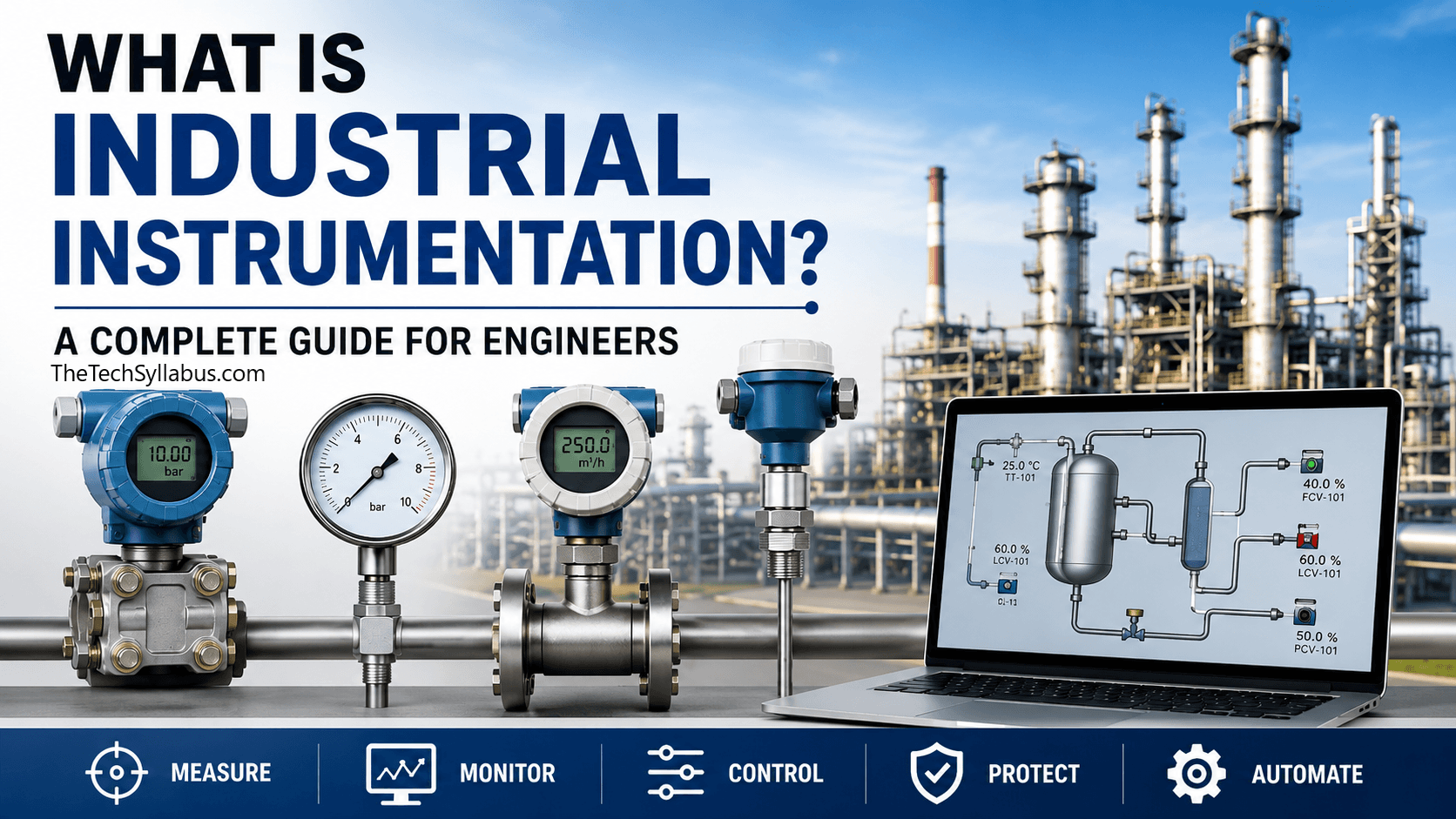
Industrial Instrumentation is the backbone of modern industrial automation. This guide explains instrumentation principles, process variables, sensors, transmitters, control systems, and real-world industrial applications.
Imagine a modern power plant, oil refinery, chemical factory, or manufacturing facility operating without any measurements, sensors, or automatic controls. Operators would have no way of knowing the process temperature, pressure, flow rate, or liquid levels. Such a plant would be inefficient, unreliable, and potentially dangerous.
This is where Industrial Instrumentation comes into play.
Industrial Instrumentation is the science and engineering discipline responsible for measuring, monitoring, and controlling industrial processes. It serves as the eyes, ears, and nervous system of every modern industrial facility.
Whether it is a power plant generating electricity, a refinery processing crude oil, or a water treatment facility supplying clean water, instrumentation systems ensure that operations remain safe, efficient, and under control.
Industrial Instrumentation is the branch of engineering that deals with the measurement and control of process variables in industrial systems.
The primary purpose of instrumentation is to provide accurate real-time information about a process and enable operators or control systems to maintain desired operating conditions.
Instrumentation systems continuously measure process conditions and send information to control systems such as PLCs, DCSs, or SCADA systems.
Based on these measurements, automatic control actions can be performed to keep the process stable and safe.
Modern industries rely heavily on instrumentation because manual monitoring is no longer practical for complex processes.
Instrumentation helps industries:
Without proper instrumentation, industries would face significant risks, including equipment failures, process instability, and safety incidents.
Industrial instrumentation primarily focuses on measuring four fundamental process variables.
Pressure measurement is critical in boilers, pipelines, compressors, tanks, and process vessels.
Common instruments include:
Example:
A boiler operating above its design pressure could become a serious safety hazard. Pressure instruments continuously monitor and protect the system.
Temperature affects product quality, equipment performance, and process efficiency.
Common instruments include:
Example:
In a steam turbine system, maintaining proper steam temperature is essential for efficient power generation.
Flow measurement determines how much liquid, gas, or steam is moving through a pipeline.
Common flow measurement technologies include:
Example:
A refinery may measure crude oil flow continuously to monitor production rates and inventory.
Level measurement indicates the quantity of liquid or material inside a tank or vessel.
Common level instruments include:
Example:
A low water level in a boiler drum can lead to severe equipment damage if not detected promptly.
A typical industrial instrumentation system consists of the following components:
Sensors detect physical process conditions such as temperature, pressure, flow, or level.
Transmitters convert sensor signals into standard electrical signals that can be transmitted to control systems.
Typical output signals include:
Controllers compare measured values with desired setpoints and determine corrective actions.
Examples:
These devices physically adjust the process.
Examples:
Consider a simple water storage tank.
The objective is to maintain a constant water level.
This automatic control loop operates continuously without human intervention.
Industrial instrumentation is used in almost every major industry, including:
Wherever a process needs monitoring or control, instrumentation plays a critical role.
Industrial instrumentation is rapidly evolving with advancements in digital technologies.
Emerging trends include:
Future industrial facilities will become increasingly intelligent, connected, and autonomous.
Industrial Instrumentation is the engineering discipline responsible for measuring, monitoring, and controlling industrial processes using sensors, transmitters, controllers, and control systems.
The four primary process variables are Pressure, Temperature, Flow, and Level.
Instrumentation improves safety, efficiency, product quality, reliability, and automation in industrial facilities.
It is widely used in power plants, oil and gas facilities, chemical plants, water treatment plants, pharmaceutical industries, and manufacturing facilities.
An Instrumentation Engineer designs, installs, calibrates, troubleshoots, and maintains instrumentation and control systems used in industrial processes.
International Society of Automation (ISA)