Physical Address
Lahore, Punjab, Pakistan
Physical Address
Lahore, Punjab, Pakistan

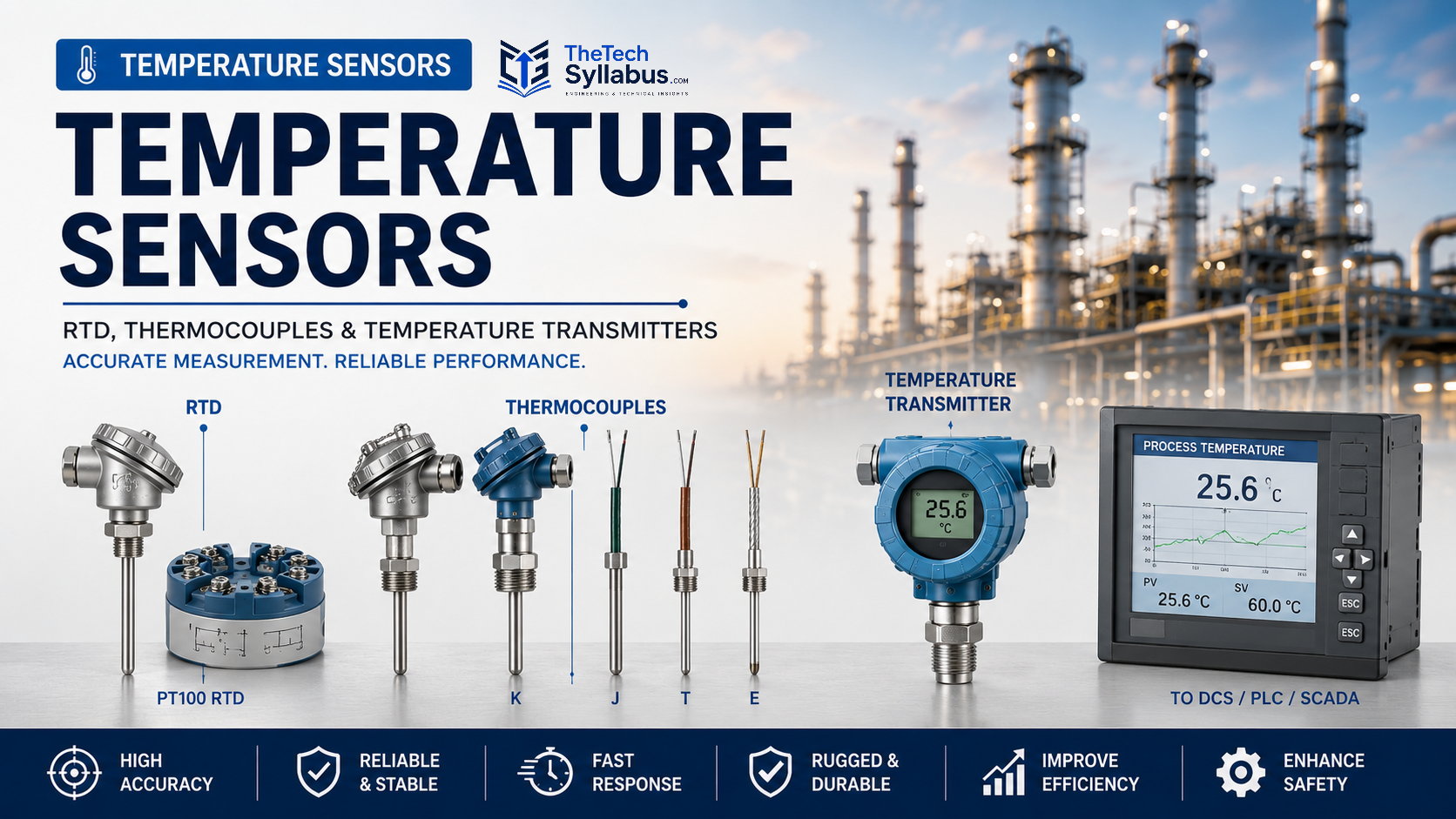
Learn how temperature sensors work, including RTDs, thermocouples, and temperature transmitters. Discover their applications, advantages, and role in industrial automation.
Temperature is one of the most important process variables in industrial plants. Whether it is a power plant, oil refinery, chemical facility, food processing unit, or pharmaceutical plant, maintaining the correct temperature is essential for safe and efficient operation.
Even a small temperature deviation can affect product quality, reduce equipment life, increase energy consumption, or cause process failures.
This is why industries use temperature sensors to continuously monitor and control temperature throughout the process.
In this guide, we will explore temperature sensors, their working principles, common types, applications, advantages, and selection criteria.
A temperature sensor is a device that detects temperature and converts it into a measurable signal that can be monitored by operators or control systems.
The measured temperature is typically transmitted to:
Temperature sensors are widely used in industrial automation to ensure process stability, safety, and efficiency.
Accurate temperature measurement helps industries:
For example, in a power plant boiler, excessive temperature can damage tubes, while low temperature can reduce efficiency.
Temperature sensors detect changes in temperature and convert them into electrical signals.
The signal is then processed by a transmitter or control system.
The most commonly used industrial temperature measurement devices are:
An RTD is a temperature sensor that measures temperature by detecting changes in electrical resistance.
As temperature increases, the resistance of the RTD element also increases.
The most common RTD used in industry is:
The “Pt” stands for Platinum.
The “100” indicates a resistance of 100 ohms at 0°C.
RTDs operate on a simple principle:
Because platinum has highly predictable characteristics, RTDs provide excellent accuracy and stability.
-200°C to +600°C
A thermocouple is a temperature sensor consisting of two dissimilar metal wires joined together.
When the junction experiences temperature changes, a small voltage is generated.
This voltage is proportional to temperature.
Thermocouples operate based on the Seebeck Effect.
The temperature difference between two junctions generates a voltage signal.
The transmitter converts this voltage into temperature values.
Most widely used thermocouple.
Range:
-200°C to +1260°C
Common in industrial applications.
Range:
0°C to +760°C
Suitable for low-temperature applications.
Range:
-200°C to +350°C
Used in high-temperature furnace applications.
A temperature transmitter converts signals from RTDs or thermocouples into a standardized output signal.
Typical output signals include:
The transmitter sends accurate temperature data to PLCs, DCSs, and SCADA systems.
Temperature transmitters provide:
A typical temperature measurement loop consists of:
Together, these components provide real-time temperature monitoring and control.
| Feature | RTD | Thermocouple |
|---|---|---|
| Accuracy | High | Moderate |
| Stability | Excellent | Good |
| Temperature Range | Moderate | Very Wide |
| Cost | Higher | Lower |
| Response Time | Slower | Faster |
| Industrial Use | Precision Measurement | High Temperature Applications |
When selecting a temperature sensor, engineers should consider:
Can the sensor withstand the expected process temperature?
Does the application require high precision?
Consider vibration, humidity, corrosion, and hazardous areas.
Fast-changing processes may require thermocouples.
Select proper thermowells, mounting methods, and cable routing.
Temperature sensors are used in:
Virtually every industrial process relies on temperature measurement.
Modern industries are increasingly adopting:
These technologies improve reliability, reduce maintenance costs, and support Industry 4.0 initiatives.
RTDs, particularly Pt100 RTDs, are generally considered the most accurate industrial temperature sensors.
RTDs provide higher accuracy and stability, while thermocouples offer wider temperature ranges and faster response times.
A temperature transmitter converts sensor signals into standardized outputs such as 4-20 mA for reliable transmission to PLCs and DCS systems.
Temperature sensors are widely used in power plants, oil and gas facilities, chemical plants, food industries, pharmaceutical manufacturing, and water treatment facilities.
https://thetechsyllabus.com/category/industrial-automation