Physical Address
Lahore, Punjab, Pakistan
Physical Address
Lahore, Punjab, Pakistan

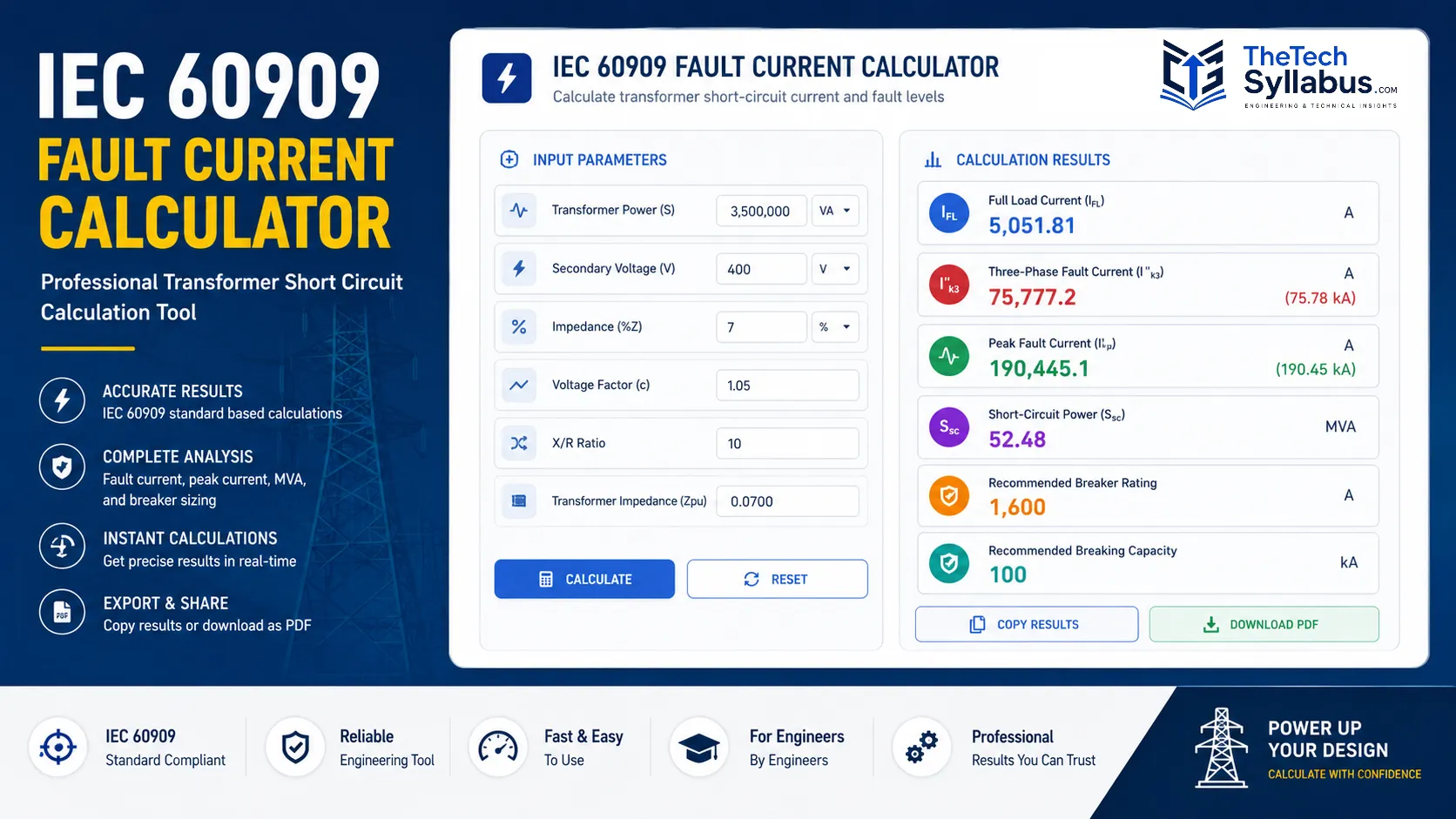
The IEC 60909 Transformer Fault Current Calculator is a professional electrical engineering tool designed to calculate transformer short-circuit current, fault level, peak fault current, short-circuit MVA, and recommended circuit breaker ratings.
This calculator follows the IEC 60909 standard methodology and helps engineers, consultants, students, and power system professionals perform quick fault current calculations for low-voltage and medium-voltage transformer systems.
Simply enter the transformer rating, secondary voltage, impedance (%Z), voltage factor, and X/R ratio to instantly determine fault current values and breaker selection recommendations.
1,000 kVA = 1 MVA
400 V = 0.4 kV
Typical: 4% – 7%
Typical: 3–15
Enter transformer parameters and click Calculate Fault Current.
Run a calculation to view detailed step‑by‑step formula substitutions.
IEC 60909 Disclaimer: Calculations are based on IEC 60909 transformer short-circuit methodology. Results are intended for engineering estimation and educational purposes. Final protection studies require complete system impedance data and professional judgement. This tool does not calculate line‑to‑line or line‑to‑ground faults.
What is IEC 60909?
Answer:
IEC 60909 is an international standard used to calculate short-circuit currents in three-phase AC power systems. It provides a standardized method for determining fault levels and selecting protection equipment.
How is transformer fault current calculated?
Answer:
Transformer fault current is calculated using transformer rated power, secondary voltage, impedance percentage (%Z), and the IEC 60909 voltage factor.
Why is transformer impedance important?
Answer:
Transformer impedance limits fault current during short circuits. Lower impedance results in higher fault current, while higher impedance reduces fault current levels.
Can this calculator be used for breaker sizing?
Answer:
Yes. The calculator provides recommended breaker current ratings and breaking capacities based on calculated fault levels.
What is short-circuit MVA?
Answer:
Short-circuit MVA represents the fault power available at the fault location and is commonly used in power system analysis and equipment selection.