Physical Address
Lahore, Punjab, Pakistan
Physical Address
Lahore, Punjab, Pakistan

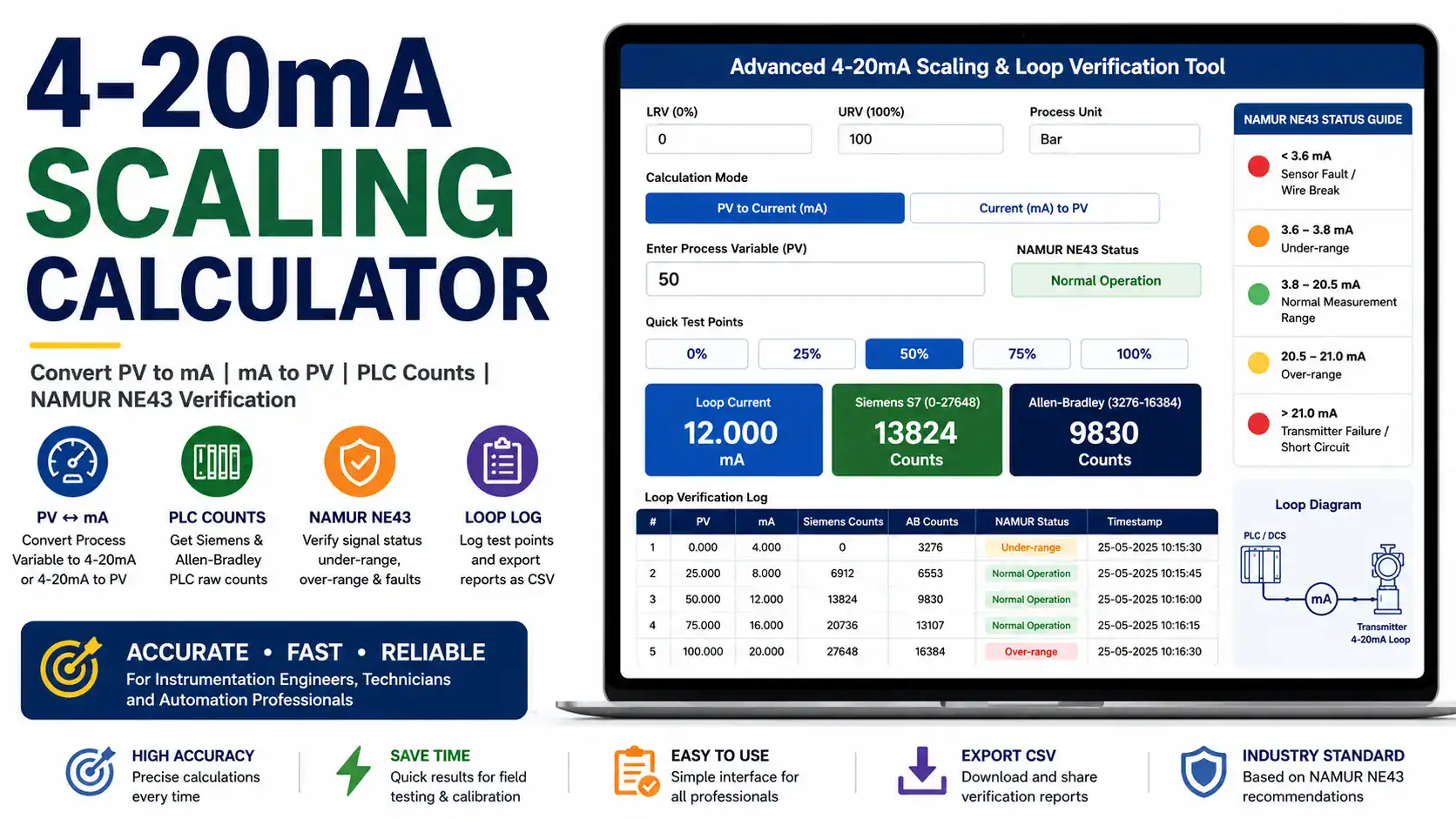
The Advanced 4-20mA Scaling Calculator helps instrumentation engineers convert Process Variables (PV) to loop current, calculate PLC analog counts, and verify transmitter diagnostics according to NAMUR NE43 standards.
Industrial Instrumentation, PLC Counts & NAMUR NE43 Analytics
| PV Value | Loop Current | Siemens Counts | NAMUR Status |
|---|
A 4-20mA Scaling Calculator is an engineering tool used to convert a Process Variable (PV) into the corresponding 4-20mA analog current signal, and vice versa. It simplifies transmitter calibration, PLC analog input scaling, loop testing, and instrumentation commissioning.
The calculator follows the industry-standard linear scaling formula used in process automation systems and supports engineering units such as pressure, temperature, flow, level, and any custom process variable. It also provides PLC raw counts and transmitter diagnostics based on the NAMUR NE43 standard, making it an essential tool for instrumentation engineers, automation engineers, technicians, and commissioning teams.
Use this mode to calculate the exact loop current (mA) for any process value within the configured measurement range.
Simply enter the Lower Range Value (LRV), Upper Range Value (URV), and the current Process Variable (PV). The calculator instantly determines the corresponding 4-20mA output current using the standard linear scaling equation.
This feature is particularly useful when:
This mode converts an analog loop current back into the corresponding engineering value.
It is commonly used during field maintenance when a technician measures loop current with a multimeter and needs to determine the actual process value represented by the transmitter.
Typical applications include:
Siemens PLC analog input modules convert the incoming 4-20mA signal into digital values ranging from 0 to 27648.
This calculator automatically converts the loop current into Siemens raw counts, eliminating manual calculations during PLC programming and commissioning.
It is compatible with popular Siemens PLC families including:
The calculated values can be directly used for PLC scaling and HMI engineering.
Allen-Bradley ControlLogix and CompactLogix analog modules represent a 4-20mA signal using raw digital counts, typically ranging from 3277 to 16384, depending on module configuration.
This calculator automatically converts loop current into Allen-Bradley analog counts, allowing engineers to verify PLC inputs quickly without manual scaling calculations.
It is ideal for:
The calculator continuously evaluates the measured loop current according to the NAMUR NE43 recommendation.
NAMUR NE43 defines standardized current ranges that distinguish between normal measurements, under-range conditions, over-range conditions, and transmitter failures.
The calculator automatically indicates whether the signal is:
This helps engineers quickly identify wiring problems, transmitter failures, and abnormal process conditions without additional calculations.
The built-in Loop Verification Log allows users to record multiple calibration points during testing.
Each logged entry includes:
The complete verification sheet can be exported as a CSV file, making it ideal for:
4-20mA scaling is the process of converting an engineering value such as pressure, temperature, flow, or level into a standard analog current signal used by industrial control systems.
A 4mA signal provides a live zero, allowing the control system to distinguish between a valid minimum measurement and a wiring or transmitter fault.
Yes. The calculator supports both Process Variable to 4-20mA and 4-20mA to Process Variable conversions using standard linear scaling equations.
The calculator currently supports:
Additional PLC platforms can be added in future updates.
NAMUR NE43 is an international recommendation that defines analog current limits for identifying transmitter faults, wire breaks, under-range, and over-range conditions in 4-20mA instrumentation loops.
Yes. It is designed for calibration engineers, instrumentation technicians, PLC programmers, commissioning engineers, and maintenance personnel to verify transmitter outputs and PLC analog input scaling accurately.