Physical Address
Lahore, Punjab, Pakistan
Physical Address
Lahore, Punjab, Pakistan

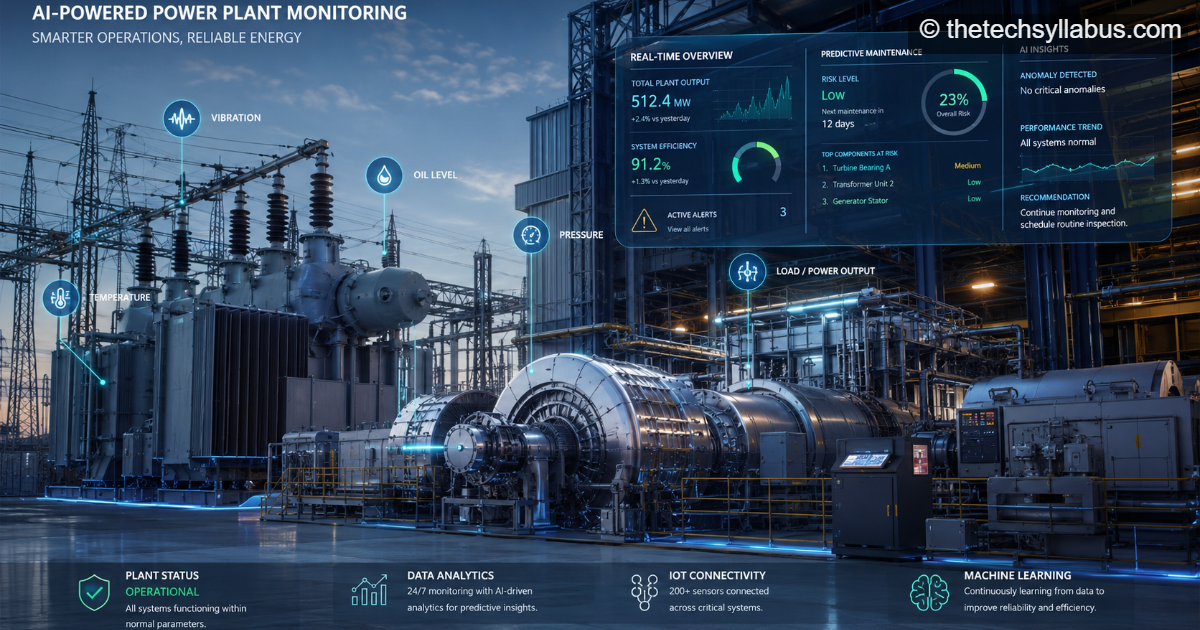
Transformers and generators are among the most critical assets in power plants, industrial facilities, and electrical substations. These machines operate continuously under electrical, thermal, and mechanical stress. A single unexpected failure can result in costly downtime, equipment damage, safety risks, and significant financial losses.
Traditionally, maintenance strategies relied on either preventive maintenance (scheduled inspections) or reactive maintenance (repairing equipment after failure). While these methods have been effective for decades, they often fail to detect hidden problems developing inside equipment.
Today, Industry 4.0 technologies are transforming maintenance practices. Artificial Intelligence (AI), Machine Learning (ML), Industrial Internet of Things (IIoT), and predictive analytics are enabling engineers to detect equipment faults before they become critical.
This shift from time-based maintenance to condition-based maintenance is improving reliability, reducing costs, and extending equipment lifespan.
AI-based fault detection uses machine learning algorithms to analyze large volumes of operational data collected from sensors installed on transformers and generators.
Instead of waiting for alarm limits to be exceeded, AI continuously learns the normal behavior of equipment and identifies unusual patterns that may indicate developing faults.
Typical monitored parameters include:
By analyzing these parameters in real time, AI can identify abnormalities weeks or even months before a failure occurs.
Transformers are static electrical devices but remain vulnerable to insulation degradation, overheating, internal arcing, and mechanical stress.
Dissolved Gas Analysis is one of the most important diagnostic tools for transformer health assessment.
When insulation materials or transformer oil experience electrical or thermal stress, gases are generated inside the oil.
Common gases include:
Traditionally, engineers use Rogers Ratio or Duval Triangle methods to interpret gas concentrations.
AI models such as:
can analyze thousands of historical fault records and automatically classify transformer faults with very high accuracy.
The system can identify:
without requiring manual interpretation.
Heat is the primary factor affecting transformer insulation life.
AI continuously evaluates:
Using these variables, the AI creates a digital thermal model of the transformer.
When actual temperatures begin deviating from predicted temperatures, the system issues an early warning.
Transformer Rating = 20 MVA
Voltage = 33 kV
Full Load Current:
I = S / (√3 × V)
I = 20,000,000 / (1.732 × 33,000)
I = 349.9 A
Approximately:
Full Load Current = 350 A
If AI detects abnormal temperature rise while current remains near 350 A, it may indicate:
Transformer insulation naturally deteriorates over time.
AI models analyze historical operating temperatures and loading patterns to estimate insulation aging rates and predict remaining useful life (RUL).
This helps utilities plan replacement strategies years in advance.
Unlike transformers, generators contain rotating components operating at high speeds.
As a result, mechanical faults often develop rapidly.
Vibration analysis is one of the most powerful predictive maintenance tools for rotating machinery.
Common generator vibration faults include:
AI systems continuously analyze vibration signatures and compare them against healthy operating conditions.
Normal Vibration = 2 mm/s
Measured Vibration = 5 mm/s
Percentage Increase:
((5 – 2) / 2) × 100
= 150%
A 150% increase indicates a serious abnormal condition that requires investigation.
AI can detect this trend long before operators notice any problem.
Machine learning algorithms often use Fast Fourier Transform (FFT) data.
FFT converts vibration signals into frequency components, allowing AI to identify fault-specific frequencies.
Examples include:
This enables early-stage fault detection before visible symptoms appear.
Partial discharge is a major indicator of insulation deterioration in high-voltage generator stator windings.
Modern AI systems use Convolutional Neural Networks (CNNs) to analyze:
The AI distinguishes between:
with significantly higher accuracy than traditional methods.
A typical AI maintenance architecture consists of five stages:
Sensors continuously monitor:
Data is transferred through:
Raw data is cleaned and converted into useful information.
Machine learning algorithms compare live data against historical healthy operating conditions.
Instead of simply triggering alarms, AI provides:
Assume:
Current Health Index = 0.50
Failure Threshold = 0.60
Health Deterioration Rate = 0.01 per month
Remaining Useful Life:
RUL = (0.60 − 0.50) / 0.01
RUL = 10 Months
The maintenance team now has approximately 10 months to plan repairs before failure occurs.
Early fault detection prevents unexpected shutdowns and production losses.
Maintenance activities are performed only when required instead of following rigid schedules.
Equipment remains available for longer periods.
Early intervention prevents severe damage and slows equipment degradation.
Potential failures are identified before becoming dangerous situations.
Engineers can make maintenance decisions based on actual equipment condition rather than assumptions.
| Feature | Traditional Maintenance | AI-Based Maintenance |
|---|---|---|
| Inspection Method | Scheduled | Continuous |
| Fault Detection | Often Late | Early |
| Downtime | Higher | Lower |
| Maintenance Cost | Higher | Optimized |
| Asset Life | Normal | Extended |
| Decision Making | Experience-Based | Data-Driven |
Despite its advantages, AI implementation comes with challenges:
However, the long-term savings usually outweigh these initial costs.
Future AI systems will combine:
These technologies will allow electrical assets to self-monitor, self-diagnose, and even recommend corrective actions automatically.
The power industry is moving toward a future where maintenance is fully predictive rather than reactive.
AI-based fault detection uses machine learning algorithms to analyze operational data and identify abnormal equipment behavior before failures occur.
AI helps by monitoring dissolved gas analysis (DGA), temperature trends, insulation condition, and cooling system performance to detect developing faults early.
AI continuously analyzes vibration, temperature, partial discharge activity, and electrical parameters to identify mechanical and electrical issues before breakdowns happen.
Common sensors include vibration sensors, temperature sensors, dissolved gas monitors, current transformers, voltage sensors, acoustic sensors, and partial discharge detectors.
No. AI is a decision-support tool that helps engineers identify potential problems earlier. Final maintenance decisions still require engineering judgment and expertise.
The main benefits include reduced downtime, lower maintenance costs, improved equipment reliability, longer asset life, and enhanced operational safety.
References
IEC 60076 Power Transformers
IEEE C57 Transformer Monitoring Guide
IEEE Generator Maintenance Guidelines