Physical Address
Lahore, Punjab, Pakistan
Physical Address
Lahore, Punjab, Pakistan

IEC 60038 · Circuit Current Derivation
Solve for current (A) on DC, single-phase AC and three-phase AC circuits, with a full step-by-step derivation.
The IEC Current Calculator is a free, professional-grade online tool designed to calculate electrical current (amperes) for DC, single-phase AC, and three-phase AC circuits. Whether you are an electrical engineer, a technician, or an engineering student, this tool simplifies complex circuit current derivations while providing a transparent, step-by-step breakdown of every calculation.
Unlike basic calculators that only give you a final number, this tool follows the IEC 60038 standard for voltage ratings and shows you exactly how the result is derived—making it equally valuable for design verification, cable sizing, circuit breaker selection, and learning purposes.
The IEC 60038 is an international standard that specifies standard voltage values for electrical supply systems. It serves as a reference for equipment and system design worldwide.
Key voltage levels defined by IEC 60038 include:
| System Type | Voltage Levels |
|---|---|
| Low Voltage (LV) | 50–1000 Vrms (AC) / 120–1500 V (DC) |
| High Voltage (HV) | >1000 Vrms |
| Standard Frequencies | 50 Hz and 60 Hz |
The standard covers both AC and DC systems and has been updated over the years, with the latest version being IEC 60038:2009+A1:2021. Common nominal voltages include 230 V (single-phase) and 400/690 V (three-phase).
By aligning with IEC 60038, this calculator ensures your calculations are based on internationally recognized reference values.
Using the IEC Current Calculator is straightforward:
The calculator automatically selects the appropriate formula based on your chosen system type:
When using VA, kVA, or MVA units, the power factor is automatically excluded because apparent power (S) already represents the product of voltage and current:
Single-Phase AC (Apparent):
Three-Phase AC (Apparent):
Where:
These formulas are derived from fundamental electrical principles and are widely used in power system design.
This free IEC current calculator computes electrical current (Amperes) for DC, Single-phase AC, and Three-phase AC systems. It adheres to IEC 60038 standards and provides a complete mathematical derivation alongside the final numeric result.
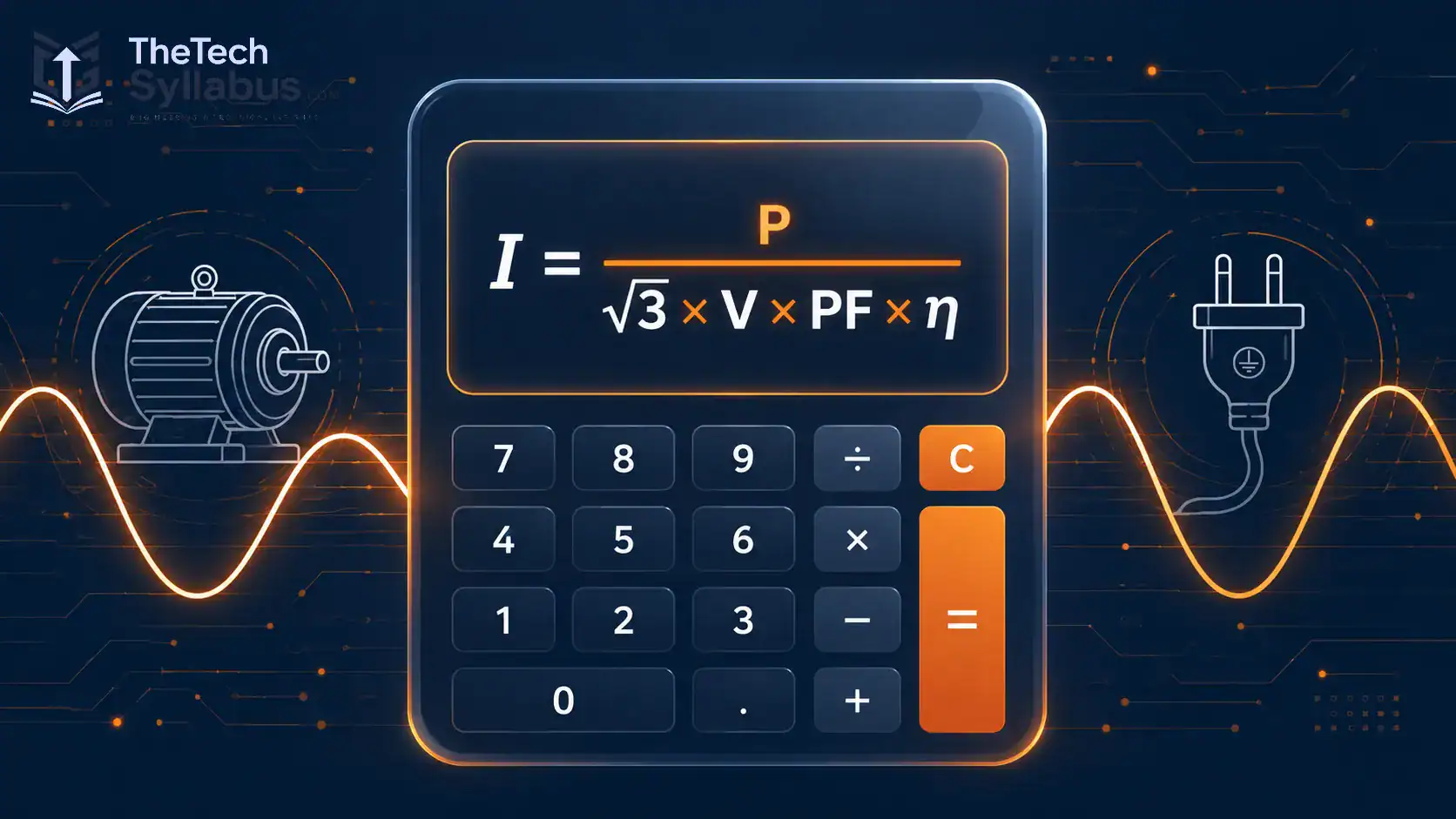
It uses I=P/(V×η) for DC, I=P/(V×PF×η) for single-phase AC, and I=P/(3×V×PF×η) for three-phase AC. It automatically selects the correct formula based on your chosen system type.
Power Factor (PF) is crucial because it measures how effectively electrical power is converted into useful work in AC circuits. If you ignore PF, your calculated current will be inaccurate, leading to incorrect cable sizes and potential overheating of conductors.
Yes, absolutely. You can select VA, kVA, or MVA under the “Power Unit” dropdown. When using apparent power units, the Power Factor field is automatically grayed out because S (Apparent Power) already represents the product of V and I without needing PF.
This tool is designed for electrical engineers, technicians, students, and anyone involved in cable sizing, circuit breaker selection, motor load analysis, or power distribution design.
The calculator uses precise mathematical formulas and supports up to 4 decimal places. For engineering purposes, results are accurate to within rounding errors. Always consult relevant standards and local regulations for final design decisions.