Physical Address
Lahore, Punjab, Pakistan
Physical Address
Lahore, Punjab, Pakistan

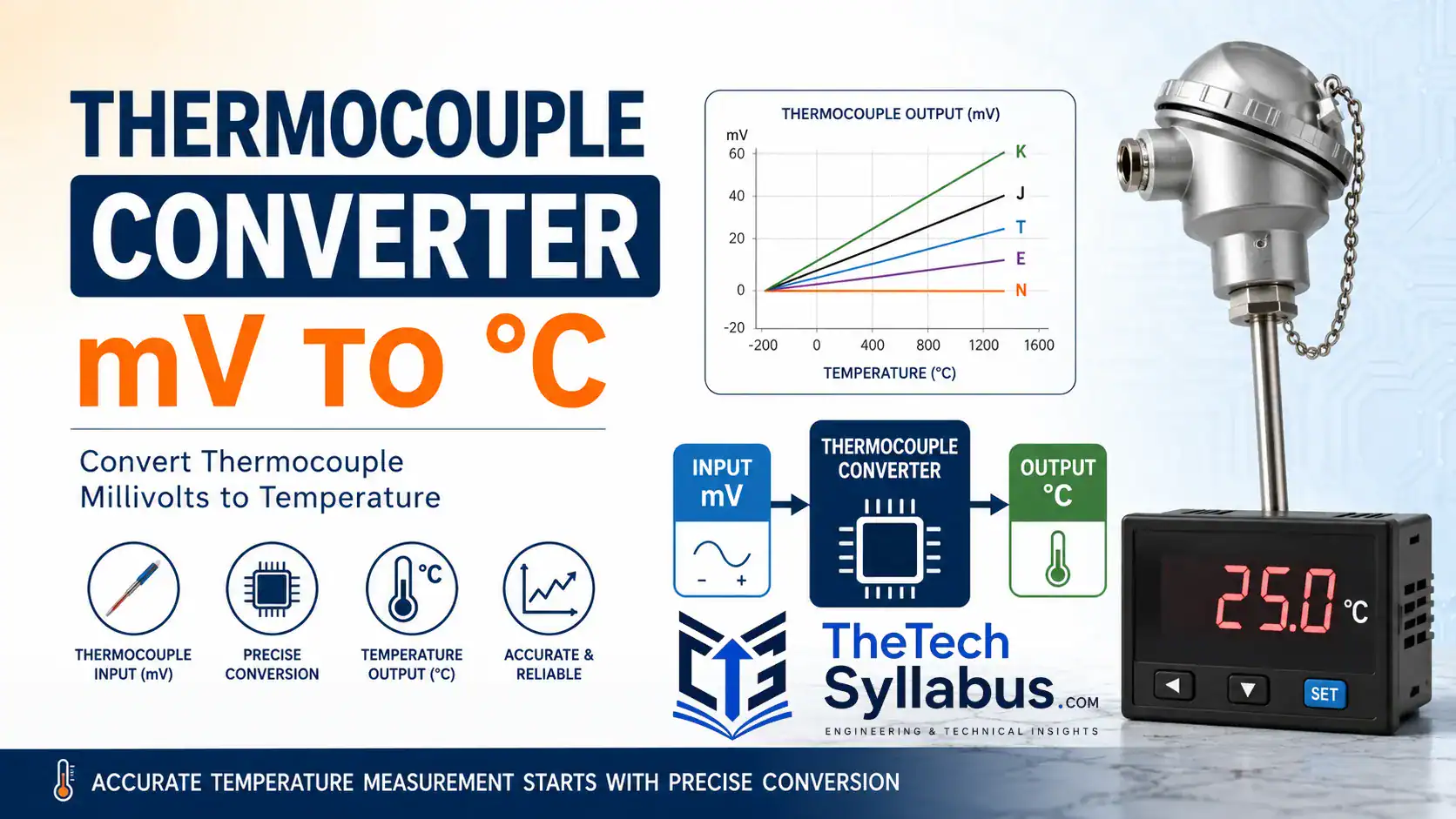
Convert thermocouple mV to Celsius or Celsius to mV for Type B, E, J, K, N, R, S, and T thermocouples using IEC 60584 reference equations.
Use this thermocouple converter to calculate the relationship between thermocouple voltage and temperature. The calculator supports both conversion directions: Celsius to millivolts and millivolts to Celsius. It works with the common IEC 60584 thermocouple types B, E, J, K, N, R, S, and T.
Thermocouples do not produce a linear signal. Their output voltage changes with temperature according to a polynomial relationship. That is why a proper thermocouple calculator is more accurate than a simple fixed sensitivity value such as 41 microvolts per degree Celsius for Type K. Approximate sensitivity is useful for quick checks, but engineering calculations should use the correct thermocouple reference equations.
A thermocouple converter is a calculation tool that converts thermocouple electromotive force, usually measured in millivolts, into temperature. It can also calculate the expected thermocouple voltage for a known temperature.
The two most common conversions are:
For example, a Type K thermocouple produces about 4.096 mV at 100 degrees Celsius. The exact value depends on the official reference polynomial used for the selected thermocouple type.
This thermocouple converter supports the IEC 60584 standard thermocouple types listed below.
| Type | Materials | Temperature Range |
|---|---|---|
| Type B | Pt30Rh/Pt6Rh | 0 to 1820 °C |
| Type E | NiCr/CuNi | -270 to 1000 °C |
| Type J | Fe/CuNi | -210 to 1200 °C |
| Type K | NiCr/NiAl | -270 to 1372 °C |
| Type N | NiCrSi/NiSiMg | -270 to 1300 °C |
| Type R | Pt13Rh/Pt | -50 to 1768 °C |
| Type S | Pt10Rh/Pt | -50 to 1768 °C |
| Type T | Cu/CuNi | -270 to 400 °C |
Each thermocouple type uses different materials, has a different useful temperature range, and produces a different voltage-temperature curve.
Follow these steps to use the calculator:
The result panel also shows the selected thermocouple range and a warning if the entered value is outside the supported range.
When converting Celsius to millivolts, the calculator uses the selected thermocouple reference function. The general equation is:
E = c0 + c1T + c2T² + c3T³ + ... + cnTn
Where:
Some thermocouple types use more than one polynomial range. For example, Type K uses different coefficients below and above 0 °C. The calculator automatically selects the correct polynomial range based on the input temperature.
When converting millivolts to Celsius, the calculator uses inverse polynomial equations. The general equation is:
T = d0 + d1E + d2E² + d3E³ + ... + dnEn
Where:
Inverse conversion is useful when a measuring instrument, data acquisition system, or transmitter gives you the thermocouple voltage and you need to calculate the temperature.
Different thermocouple types are made from different metal combinations. Because of this, they produce different voltage outputs for the same temperature. A Type K thermocouple and a Type J thermocouple do not generate the same millivolt signal at 100 °C.
Selecting the wrong thermocouple type can cause a large temperature error. Always confirm the sensor type before using a thermocouple conversion table or calculator.
Thermocouples are widely used because they are rugged, affordable, and suitable for a wide temperature range. Common applications include:
Type K is one of the most common general-purpose thermocouples. Type J is often used in older industrial systems. Type T is useful for low-temperature work, while Type R, Type S, and Type B are used for high-temperature applications.
Thermocouple sensitivity is usually expressed in microvolts per degree Celsius. It describes how much the thermocouple voltage changes for each degree of temperature change.
Approximate sensitivities include:
| Type | Approximate Sensitivity |
|---|---|
| Type B | 10 µV/°C |
| Type E | 68 µV/°C |
| Type J | 50 µV/°C |
| Type K | 41 µV/°C |
| Type N | 39 µV/°C |
| Type R | 10 µV/°C |
| Type S | 10 µV/°C |
| Type T | 43 µV/°C |
These values are only approximate. The actual voltage-temperature relationship is nonlinear, so the calculator uses polynomial equations instead of a single fixed sensitivity value.
A real thermocouple measurement normally requires cold junction compensation. The thermocouple voltage depends on the temperature difference between the measuring junction and the reference junction.
This calculator converts between thermocouple EMF and temperature using standard reference relationships. In practical measurement systems, cold junction compensation must be handled by the instrument, transmitter, DAQ module, or measurement circuit.
A thermocouple converter is a tool that converts thermocouple voltage in millivolts to temperature in degrees Celsius, or converts temperature to the expected thermocouple millivolt output.
A Type K thermocouple produces approximately 4.096 mV at 100 °C when calculated using the standard reference polynomial.
No. Each thermocouple type has its own polynomial coefficients. Type B, E, J, K, N, R, S, and T thermocouples all have different voltage-temperature relationships.
Thermocouple voltage is generated by the Seebeck effect, and the relationship between temperature and voltage is not perfectly linear. Polynomial equations are used for accurate conversion.
The calculator performs standard thermocouple EMF and temperature conversion. Cold junction compensation is a separate measurement requirement that must be handled in real instruments and circuits.