Physical Address
Lahore, Punjab, Pakistan
Physical Address
Lahore, Punjab, Pakistan

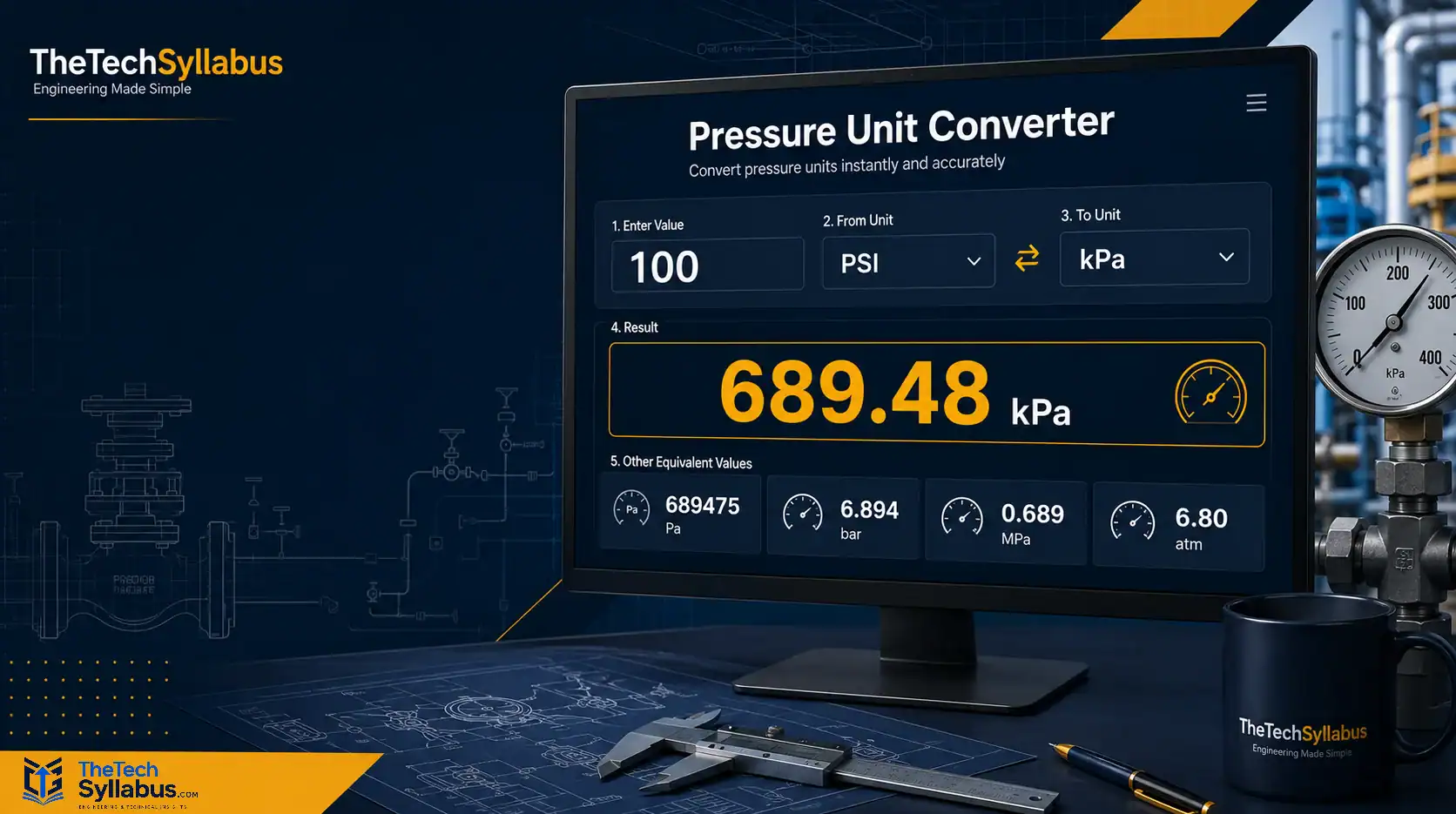
Convert pressure instantly between PSI, kPa, MPa, Bar, Pascal, atm, Torr, mmHg and more with our free, accurate engineering Pressure Unit Converter.
| Unit | Pascal (Pa) | bar | psi | atm | kg/cm² | Reverse (1 Pa =) |
|---|
Absolute Pressure: Measured relative to perfect vacuum. Used in scientific and engineering calculations.
Gauge Pressure: Measured relative to ambient atmospheric pressure. Most common in industrial applications.
Vacuum Pressure: Negative gauge pressure, measured below atmospheric pressure.
Differential Pressure: The difference between two pressure points in a system.
Oil & Gas – Pipeline pressure monitoring, wellhead control
Power Plants – Boiler pressure, steam turbine control
HVAC – Air duct pressure, refrigerant pressure
Hydraulics – Fluid power systems, press control
Pneumatics – Compressed air systems, actuators
Instrumentation – Process control, pressure transmitters
To convert pressure from unit A to unit B:
Value in Pa = Value in A × Conversion Factor(A)
Value in B = Value in Pa ÷ Conversion Factor(B)
Where the conversion factor is the number of Pascals in that unit.
Absolute pressure is measured relative to a perfect vacuum (zero pressure). Gauge pressure is measured relative to ambient atmospheric pressure. Vacuum pressure is negative gauge pressure.
To convert psi to kPa, multiply the psi value by 6.89475729. For example, 100 psi × 6.89475729 = 689.475729 kPa.
Standard atmospheric pressure (1 atm) equals:
Convert to Pascal (Pa) first, then to the target unit:
Value in Pa = Value × Factor(from)
Result = Value in Pa ÷ Factor(to)
Where Factor(unit) is the number of Pascals in that unit.
Pressure measurement is critical for:
The Pressure Unit Converter is a free online engineering calculator designed to convert pressure values accurately between all major SI, Metric, Imperial, and industrial pressure units. Engineers, technicians, students, maintenance professionals, and process control specialists can instantly convert pressure units without performing manual calculations.
This engineering calculator supports conversions between Pascal (Pa), Kilopascal (kPa), Megapascal (MPa), Gigapascal (GPa), Bar, Millibar, PSI, KSI, Atmosphere (atm), Technical Atmosphere (at), Torr, mmHg, inHg, kg/cm², kg/m², Inches of Water, Feet of Water, Centimeters of Water, Millimeters of Water, Newton per square meter, Newton per square millimeter, Barye, Dyne/cm², and many other commonly used engineering units.
Whether you are designing pressure vessels, selecting pressure transmitters, calculating hydraulic systems, performing pneumatic calculations, working on boilers, compressors, pipelines, HVAC systems, or industrial process plants, this pressure converter provides fast and highly accurate results.
Unlike basic online converters, this engineering tool also displays equivalent pressure values in multiple units simultaneously, making it easier to compare values and verify engineering calculations.
The Pressure Unit Converter is optimized for electrical, instrumentation, mechanical, process, chemical, and petroleum engineers who require reliable pressure conversions during design, commissioning, troubleshooting, and maintenance activities.
https://thetechsyllabus.com/category/calculators-tools